
What is ISPM-15 and Why is it Internationally Enforced?
ISPM-15 (International Standards for Phytosanitary Measures No. 15) is the global regulatory framework established by the International Plant Protection Convention (IPPC), a part of the FAO. It regulates wooden packaging material (WPM) used in international trade to prevent the transcontinental spread of destructive forest pests, such as the Asian Longhorned Beetle (ALB) and Pine Wood Nematode, which have previously caused billions of dollars in ecological damage.
The standard mandates that raw wood packaging must be treated to eliminate all stages of insects and pathogens before entering the international market.
Which Wooden Packaging Materials Must Comply?
ISPM-15 applies to all raw, non-processed wooden packaging materials thicker than 6 mm, including:
- Wooden Pallets: Block and stringer configurations, 2-way and 4-way entries.
- Wooden Crates and Boxes: Heavy machinery packaging, custom boxes, and industrial frames.
- Dunnage: Timber used to secure cargo inside shipping containers.
- Pallet Collars: Hinged wooden borders placed on top of standard pallets.
Exemption Note: Processed wood products such as plywood, particleboard, and oriented strand board (OSB) are exempt from ISPM-15 because their manufacturing processes involve high temperature and pressure, which naturally eliminate pests.
Approved Treatment Methods Under ISPM-15
The standard officially recognizes two primary treatment modalities for timber platforms:
Heat Treatment (HT)
- Heats the wood core to at least 56°C for 30 continuous minutes.
- 100% eco-friendly with zero chemical residues.
- Accepted by all importing nations.
- Code: HT
Methyl Bromide (MB) Fumigation
- Gaseous chemical fumigation under strict atmospheric parameters.
- Banned in the European Union, Canada, and Australia due to environmental risks.
- Code: MB
Heat Treatment (HT) is highly recommended for all exports to ensure hassle-free customs clearance in all international markets.
The IPPC Stamp: Components and How to Read It
Following treatment, the timber is stamped with the internationally recognized IPPC logo, which serves as a phytosanitary passport. The stamp contains:
- IPPC Symbol: The wheat sheaf icon on the left.
- Country Code: The ISO country code (e.g., EG for Egypt).
- Producer/Treatment Provider ID: A unique registration number issued by the national plant protection organization (Egyptian Ministry of Agriculture).
- Treatment Code: Either HT (Heat Treatment) or MB (Methyl Bromide).
How to Obtain an ISPM-15 Certificate in Egypt
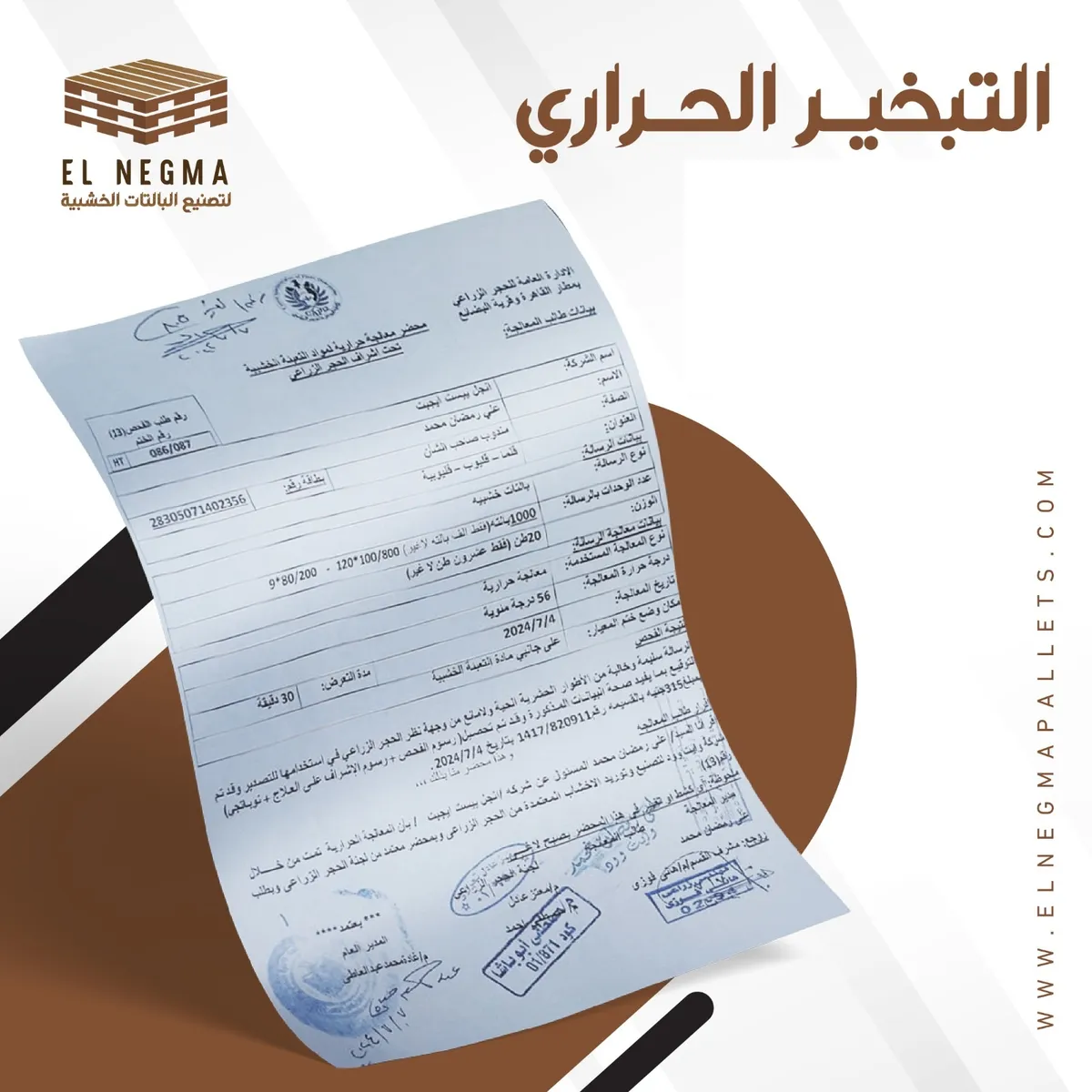
Exporters in Egypt obtain compliant wooden packaging via the following steps (see El Negma's HT and ISO certificates):
- Pallet Manufacturing: Platforms are built using raw softwood or hardwood.
- Treatment at Authorized Facility: The pallets are sent to an Egyptian Agricultural Ministry-certified HT kiln or MB chamber.
- Kiln Data Logging: Temperatures are recorded electronically via probes to verify core temperature compliance.
- Stamping: Pallets are branded with the official IPPC code showing the facility's registration number.
- Phytosanitary Certification: Plant Quarantine authorities issue a physical certificate accompanying the export documentation.
Treatment Requirements Across Key Export Destinations
ISPM-15 is enforced across more than 180 countries under the International Plant Protection Convention (IPPC). The following breakdown details official regulatory requirements in major markets:
| Market / Destination | Approved Treatment | Specific Regulations | Regulatory Body & Official Source |
|---|---|---|---|
| European Union (EU) | Heat Treatment (HT) preferred / required at most ports | Methyl Bromide use banned within the EU; strict biosecurity and occupational safety inspections at entry ports | European Commission — Regulation (EU) 2016/2031 |
| United States (USA) | Heat Treatment (HT) or Methyl Bromide (MB) | Legible IPPC mark, complete debarking, and immediate port-of-entry inspections | USDA APHIS — Wood Packaging Material |
| Australia | Heat Treatment (HT) or Methyl Bromide (MB) | Strict biosecurity compliance and treatment certificates verified under BICON standard | DAFF Biosecurity — Cargo Packaging |
| China | Heat Treatment (HT) or Methyl Bromide (MB) | IPPC branding with official phytosanitary treatment certificate compliant with Chinese customs | General Administration of Customs (GACC Decree 84) |
Consequences of Non-Compliance During Export
Failing to use compliant wood packaging can lead to severe consequences:
- Port Rejection: Custom officials will order the shipment to be returned to the origin country at the exporter's expense.
- Delays & Double Treatment Fees: If available, pallets must undergo on-site treatment at steep port fees, stalling logistics.
- Cargo Destructive Quarantine: Wood packaging may be shredded or incinerated, risking cargo safety.
- Financial Penalties: High biosecurity fines can be charged to the exporting agent.
Frequently Asked Questions About ISPM-15
Do domestic-only pallets in Egypt need ISPM-15?
No, the rule is strictly for packaging moving across international borders. Domestic transit does not require heat treatment.
Does the stamp expire?
No, the stamp remains valid as long as the pallet is intact. If repaired with new raw wood, the entire unit must be re-treated and re-stamped.