
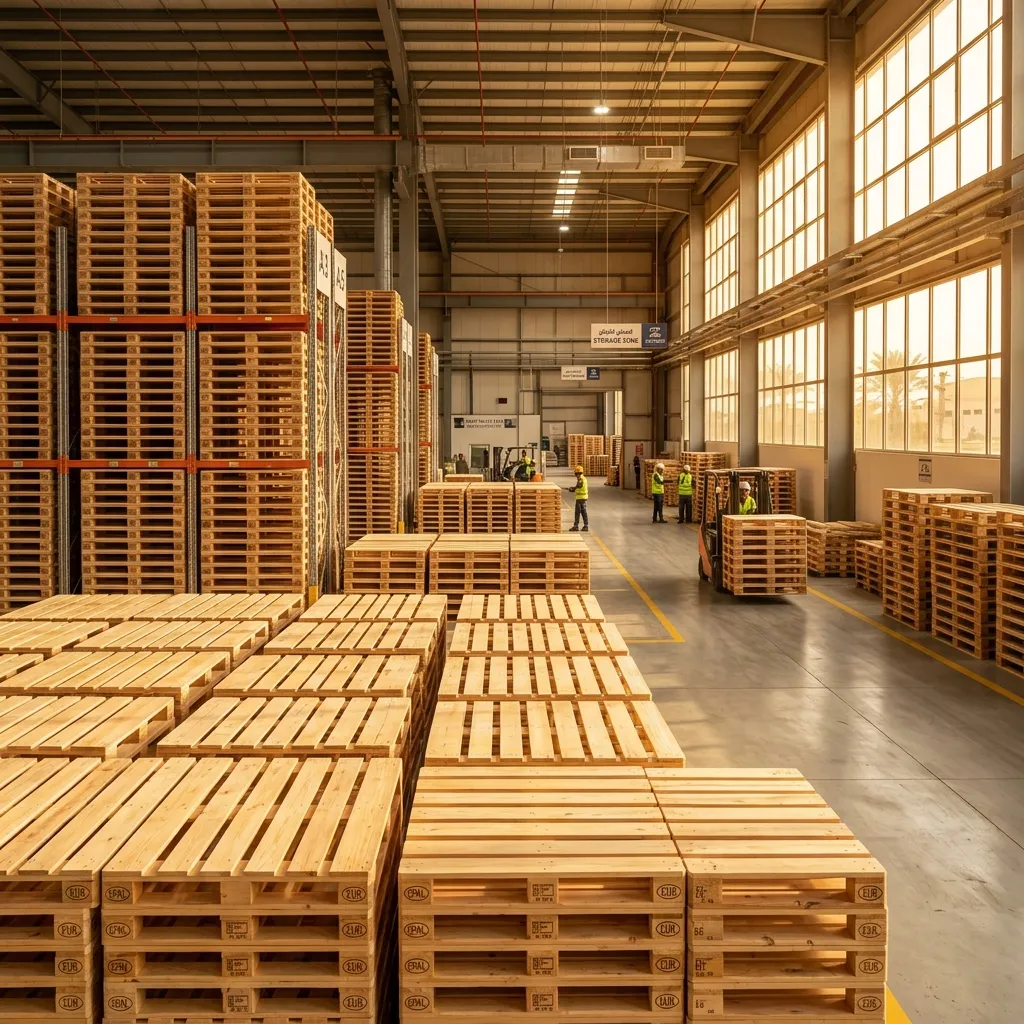
1. Introduction to Timber Pricing Dynamics
The market for wooden pallet prices in Egypt is subject to multiple commercial variables that prevent fixed and permanent price listings. Since raw timber (such as Swedish redwood and Baltic whitewood) is imported, pallet pricing is directly linked to global timber indices, ocean freight rates, and currency exchange rates. Understanding these underlying cost structures enables procurement managers to make informed decisions and build precise logistics budgets.
2. Four Engineering Parameters of Cost
When evaluating quotations for wooden pallet supply, logistics engineers calculate pricing based on four main parameters:
- Timber Volume (Board Foot / Cubic Meter): The thickness of the deck boards (e.g., from 18 mm to 22 mm) and their layout directly determine the volume of wood consumed. This is the single largest component of the pallet cost.
- Timber Species (Sowad vs. Bayad): Imported Swedish pine (Sowad) is more durable and resistant to warping but carries a higher price than Baltic whitewood (Bayad), which serves as a highly economical choice for light-to-medium loads.
- Fastener Specifications: Automated assembly using screw-shank or ring-shank nails increases structural integrity, reducing long-term cargo damage and packaging failures, though it has a higher initial assembly cost compared to standard nails.
- Quarantine Compliance (ISPM-15): International shipments mandate that wooden packaging be heat-treated (HT) in certified chambers and stamped, a step that adds a minor process cost but guarantees customs acceptance.
3. Financial Trade-offs: New vs. Used
Companies choose between new and used pallets based on budget constraints and application requirements:
| Parameter | New Wooden Pallets | Used Wooden Pallets |
|---|---|---|
| Structural Safety | Excellent, free from defects and hidden stress fractures | Variable, may have hair-line splits or protruding nails |
| Export Compliance | Fully sanitized and certified (HT stamp) | Not recommended for international export (unverifiable quarantine history) |
| Service Lifespan | Long, suitable for multiple dynamic handling cycles | Short, limited to the condition of its prior usages |
| Total Lifecycle Cost | Higher initial outlay, but yields lower repair and replacement rates | Lower purchase cost, but carries risks of cargo breakage or assembly line stops |
4. Indicative Price Averages (El Negma 2026)
Indicative wholesale averages (orders from 1,000 pallets). The general range is roughly EGP 250–1,000 for most standard sizes depending on size, timber, thickness and load — these averages rise or fall with specifications. Final price by custom quote.
| Size | Indicative Average (EGP) | Note |
|---|---|---|
| Standard 120×100 | 445 | General use |
| Industrial 120×100 | 470 | Agricultural export |
| Citrus Box 120×100 | 535 | Closed stacking frame |
| Chemical 114×114 | 915 | 4-way entry |
| Heavy Square 120×120 | 1,220 | Indicative average — priced per specification |
Non-binding indicative averages, including HT heat treatment for export. Contact +201080012261 for the final price.