
Logistical Challenges in Shipping Heavy & Chemical Freight
Chemicals, fertilizers, cement, and metal ores are typically packed in massive Jumbo Bags or industrial drums. This heavy weight exerts massive concentrated loads on supporting structures. Any mechanical failure risks hazardous material spills and severe workplace accidents, necessitating specialized heavy-duty design standards.
The Standardized Chemical Pallet Series (CP Pallets)
The European Chemical Industry Association developed the CP series (CP1 to CP9) specifically for chemical freight. The most widely used models in Egyptian industrial hubs include:
- CP1 (1000 x 1200 mm): Ideal for boxed chemicals, featuring tightly spaced top decks.
- CP3 (1140 x 1140 mm): A square platform designed to fit shipping containers perfectly without lateral gaps, widely used for raw plastics and polymer grains in big bags.
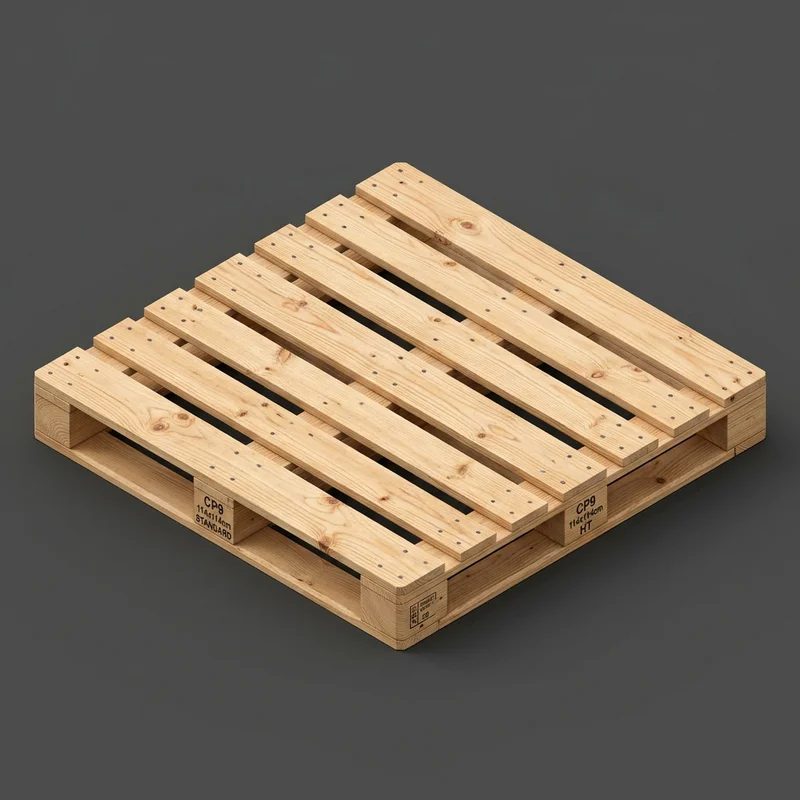
- CP9 (1140 x 1140 mm): Reinforced with a full bottom perimeter (double-deck layout), supporting vertical stacking and heavy steel drums.
Engineering Specifications for Heavy-Duty Platforms
Heavy-duty pallets rely on precise lumber selection and assembly specifications:
- Timber Thickness: Top deck boards have a thickness of 22 mm to 25 mm to withstand high bending moments.
- High-Density Lumber: Constructed using solid, knot-free beech wood or dense structural softwoods.
- Cross-Nailing Protocols: 90 mm galvanized ring-shank nails are driven in cross patterns to prevent joint loosening from container transport vibrations.
Safety Factors and Load-Bearing Capacity
In chemical logistics, structural integrity is directly linked to workplace safety:
- Reduced Slatted Gaps: Gaps between top boards are kept below 4 cm to prevent flexible bag materials from sagging or tearing.
- Rounded Edge Bevels: Boards are planed and rounded to prevent sharp corners from puncturing polymer bags.
- Recessed Fasteners: All nails are driven completely flush or below the surface to protect drums from punctures.