
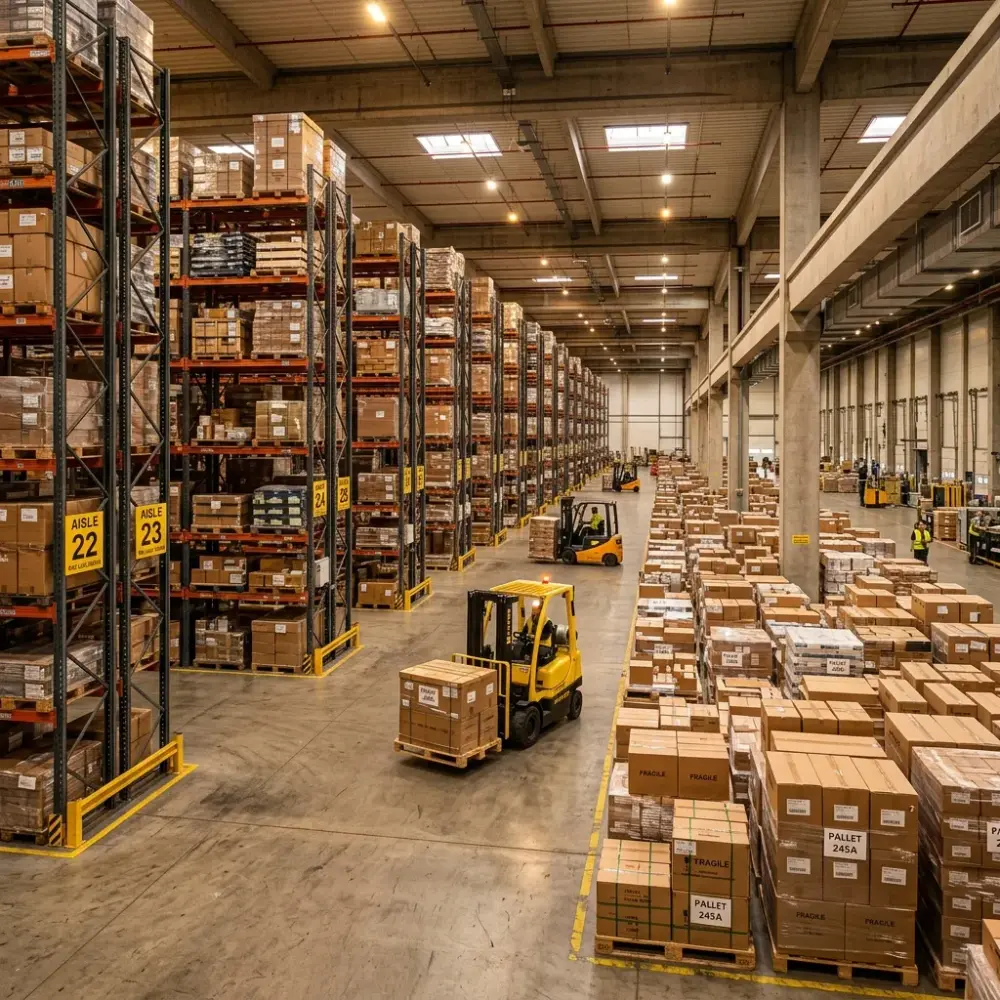
1. Storage vs Export: What's the Difference?
Many procurement managers mistakenly assume that warehouse storage pallets and international export pallets share the same specifications. In reality, the purpose determines the specification:
- Export Pallets: Must carry HT treatment and IPPC stamps to pass phytosanitary customs inspection in destination countries.
- Storage Pallets: Do not necessarily require HT certification, but must handle heavy repetitive loads, resist humidity cycles, and be fully compatible with forklift equipment and racking systems used in the facility.
In short: racking storage pallets need superior structural rigidity, while export pallets need international phytosanitary certification. El Negma manufactures both to separate specialized specifications.
2. Storage Systems and Their Pallet Requirements
- Floor Stacking: The simplest and most economical system. Pallets are stacked directly on top of each other. Requires high static load capacity (4,000 kg box design, up to 5,500 kg heavy design) and thick top boards to resist the stacked weight above.
- Selective/Drive-In Racking Systems: Pallets are supported only by two horizontal arms — no floor beneath them. Transverse rigidity of the pallet becomes critical to prevent collapse under racking loads. Bottom boards must be sturdy with minimum 100mm board width.
- ASRS (Automated Storage and Retrieval Systems): Require pallets manufactured to tight dimensional tolerances (±2mm) with fully closed top decks to enable reliable robot sensing and movement.
3. Specs for Racking-Compatible Pallets
Based on international racking load standards (EN 15512), minimum recommended warehouse pallet specs are:
- Dynamic Racking Load: Minimum 1,000 kg for selective racking applications — factory designs reach 1,250 kg open-base and 1,500 kg box-frame per the unified rating.
- Static Floor Load: Minimum 3,000 kg for conventional ground stacking — reaching 3,500 kg open-base and 4,000 kg box-frame per the certified factory table.
- Top Board Thickness: 22-25mm minimum for uniform weight distribution across the pallet surface.
- Timber Species: Musk wood or alternating pine for a cost-performance balance in internal warehouse settings.
- 4-Way Entry: Required for full forklift maneuverability in narrow-aisle warehouse configurations.
4. Common Warehouse Pallet Purchasing Mistakes
- Buying Mixed-Size Used Pallets: Non-uniform dimensions cause operational bottlenecks with racking systems and slow down loading/unloading cycles.
- Wrong Pallet Size for Aisle Width: Euro pallets (120×80cm) suit narrow aisles; Industrial pallets (120×100cm) require wider clearance for safe maneuvering.
- Skipping Regular Pallet Inspections: Cracked or broken pallets in a warehouse present a worker safety hazard and risk goods falling from racking systems.
- Over-Specifying with Export Pallets for Internal Use: Purchasing expensive HT-certified export pallets for purely internal storage is an unnecessary budget waste.